 Once the glow of they’re finally paying attention to what I say fades, some are seeing crowdsourcing as a one-sided relationship that is all about giving with no getting.
Mary Ann Chick Whiteside says Tara Hunt has hit on the some of the same problems she has with crowdsourcing.
Hunt writes in “Please Stop Crowdsourcing Me:”
I came and I thought, hey, this is kind of neat-o and it empowered me at first. I thought, “Awesome! They want my opinion! They listen!” and I offered it and the feedback was, “Great idea!” and I watched as you implemented it, then benefitted from it and I felt good. I was great at first, but then after a while, I started to feel a little dirty…a little used…a little like cheap labor, replacing people you probably laid off or decided to save money on not hiring because you were getting so much great value out of my time. Maybe it was because it seemed that you believed you could ‘tap’ my well of ideas or ‘pick my brain’ endlessly? Maybe it was because my generosity goes so far and you overstepped your bounds? Maybe it was because you had a chance to reward my efforts, but dropped me like a wet rag as soon as I asked?
Read her whole post and the comments, too.
Hunt’s post wasn’t particularly aimed at the media from what I could tell, but certainly Whiteside’s spin on it is. Whiteside asks:
Will crowdsourcing or sites using only content generated by users help to eliminate more paying jobs for those with journalism or media degrees?
Maybe, but the economic pressures for reducing the size of traditional newsrooms seems to have little to do with the trend toward user generated content or crowd-sourced journalism. Editors may be grasping at these as partial solutions for what is already happening, but they are not the root cause of sparser newsrooms.
Crowdsourcing or open-sourcing journalism has been one of those hot button topics of late 2006 and 2007. The term crowdsourcing seems to have become popular after a June 2006 article in Wired magazine. In journalism, we have ballyhooed efforts by Gannett and Assignment Zero.
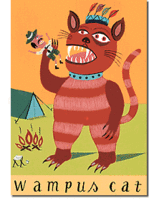
At its most cynical, crowd-sourced journalism is a Wampus cat cross of utopian volunteer collective effort for good and a bean-counter’s vision of work at zero cost.
But as Tara Hunt’s post fleshes out, crowdsourcing is about the complicated relationships with the audience or user, and that — like most interpersonal relationships — is tricky. As she says, it’s about reciprocating. And in a journalism context — maybe any context — finding the proper reciprocity will be the difference between positive aid and feeling used.
(More on Wampus cats for the curious. Illustration from The Atlantic magazine).