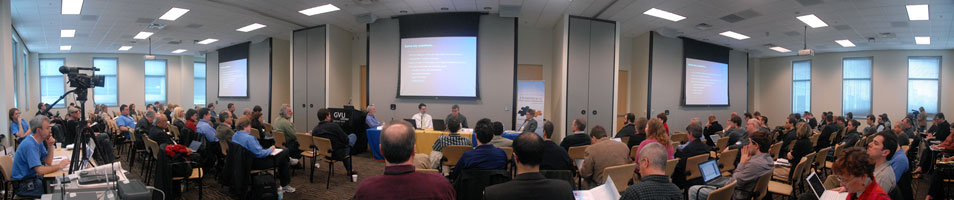
 I’m still kind of digesting and fermenting all the things I heard at the computation + journalism symposium at Georgia Tech last weekend. It also had the long name of “Journalism 3G: A Symposium on Computation & Journalism.”
Rich Gordon, a New Media journalism professor at Northwestern, called it a first date and has a great rundown on some of the key points brought up by speakers.
It also was a little like a 20th-year class reunion for an Investigative Reporters and Editor’s computer-assisted reporting bootcamp with Gordon, Shawn MacIntosh, Nora Paul, and Bill Densmore on hand, all journalists who know more than a thing or two about using technology in the practice of journalism. But that’s not quite right because a lot of the other people were either not born 20 years ago or were toddling around in diapers.
So maybe the first date analogy stands, or at least there were some Facebook pokes. Gordon did try to outline the intersection and the missed connections of journalism and computer science:
I concluded that journalists and technology professionals do have two things in common. First, the best people in both fields really do want to change the world and make it a better place. Second, both believe that people want and deserve access to the best possible information.
But there also is a substantial gap between journalism and computer science. Too many journalists don’t respect technology development as a creative activity — they think developers should just build stuff they want. Too many technologists don’t respect journalism as an intellectual activity — they think journalists just pump out content for their algorithms to process. Too many journalists really don’t like technology change; they blame it for hurting media businesses, threatening their livelihoods and diminishing the quality of news available in local communities. Too many technologists think it’s not their job to worry about the negative impact of technology innovation on media companies and journalism — and when they do think about the consequences, think only about information at the national and global level (which is broader, deeper and more accessible than ever) and not at the local level (where online news ventures rarely do the kind of original reporting that newspapers do).
He also points to another great recap of the sessions that I hadn’t seen: John Christopher Burns’ coverage here and here, who was using one of those “One Laptop Per Child” (OLPC) computers at the two-day event.
Good stuff; good conference
(Photo from conference web site.)